
Career
7 Career Skills That Stay Valuable in the Age of AI
Seven career skills remain valuable as AI changes workplace tasks. See how to build critical thinking, communication, adaptability and AI literacy.
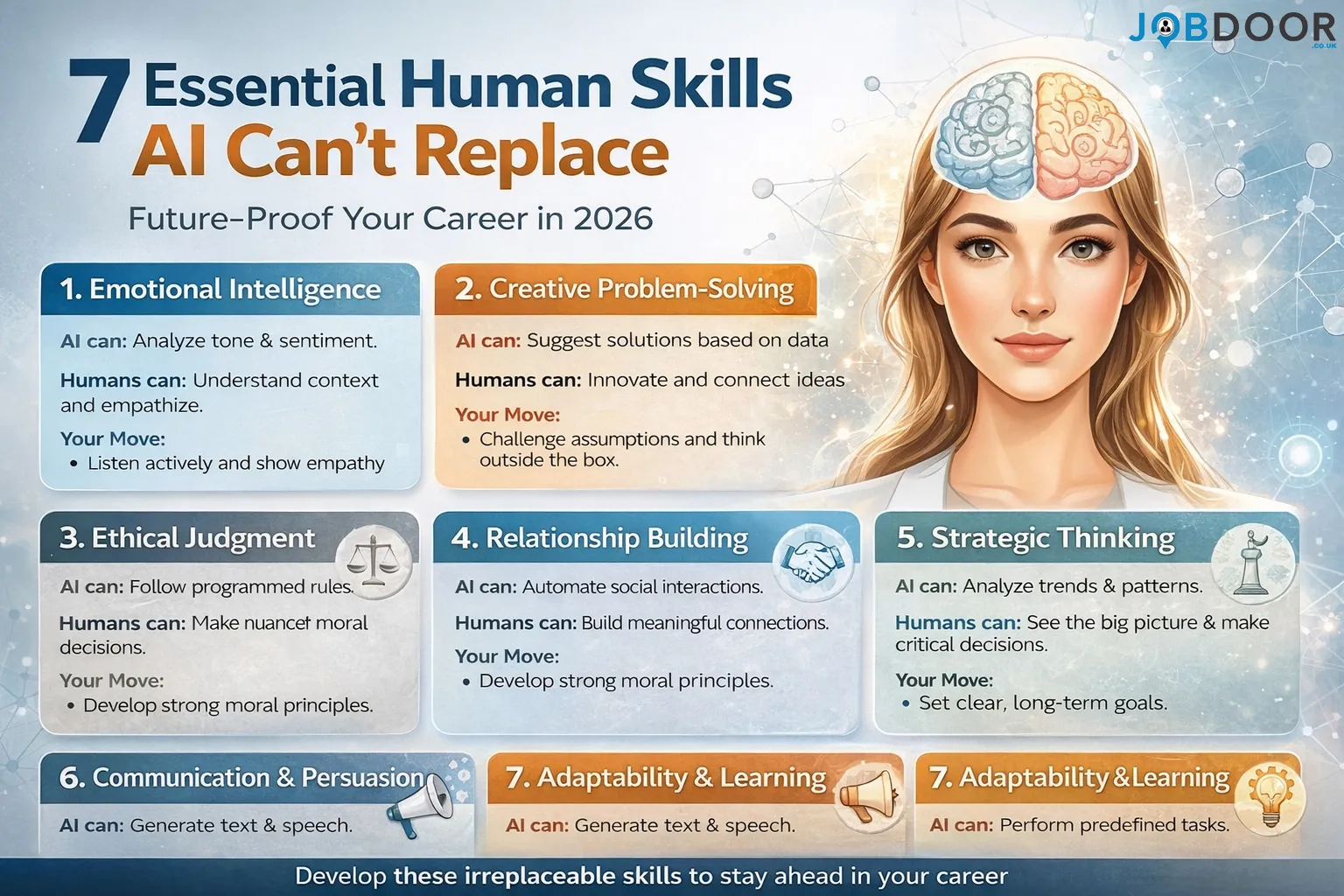
7 Career Skills That Stay Valuable in the Age of AI
AI is changing how people write, research, analyse information, communicate and complete routine work. As these tools become part of everyday jobs, the most useful career strategy is not to compete with AI at every task. It is to build skills that help you make better decisions, work with people and use technology effectively.
Some abilities are especially valuable because they depend on context, judgment, communication, responsibility and real-world experience. These skills can make you more effective whether you are starting your career, changing jobs or moving into management.
Why Career Skills Still Matter When AI Is Improving
AI can produce information and complete many tasks quickly, but workplace success involves more than completing a task. Someone still needs to decide what should be done, why it matters, whether the result is reliable and how it affects other people.
This is why the strongest approach is usually AI plus human capability. Use technology to reduce repetitive work, then use your own knowledge and judgment to improve the outcome.
The 7 Career Skills Worth Building
| Skill | Why it matters | How to build it |
|---|---|---|
| Critical thinking | Helps you question information and make sound decisions | Compare evidence and challenge assumptions |
| Communication | Helps teams understand ideas and act on them | Practise clear writing, speaking and listening |
| Emotional intelligence | Supports teamwork, leadership and difficult conversations | Improve listening, empathy and self-awareness |
| Problem-solving | Helps you handle unfamiliar situations | Break complex problems into smaller decisions |
| Adaptability | Helps you respond when tools, roles or industries change | Build a habit of trying new methods and tools |
| AI literacy | Helps you use AI productively and responsibly | Practise prompting, checking and reviewing AI output |
| Leadership and judgment | Helps you set priorities and take responsibility | Practise decisions, delegation and trade-offs |
1. Critical Thinking
Critical thinking is the ability to examine information, identify weak assumptions and reach a reasoned conclusion. It becomes more important when AI can produce convincing answers in seconds.
Instead of accepting an AI-generated answer immediately, ask:
- What evidence supports this?
- Could important information be missing?
- Does the answer fit the situation?
- What could go wrong if I act on it?
Build this skill: Compare multiple sources, explain why you reached a decision and regularly question your first answer.
2. Communication
AI can help draft emails, reports and presentations, but professionals still need to understand their audience and communicate with purpose. A technically correct message can still fail if it is unclear, insensitive or badly timed.
Useful communication habits
- Put the main point near the beginning.
- Use simple language when explaining complex topics.
- Listen before responding.
- Adapt your message to the person and situation.
- Confirm important decisions in writing.
Strong communication is valuable in almost every career because work depends on people understanding one another.
3. Emotional Intelligence
Emotional intelligence helps you understand your own reactions and respond appropriately to other people. It matters when giving feedback, managing conflict, supporting colleagues, dealing with customers or leading a team.
AI can analyse language and identify patterns, but workplace relationships still require human context and responsibility.
How to improve emotional intelligence
- Listen without immediately preparing your response.
- Notice how your behaviour affects others.
- Stay calm during difficult conversations.
- Ask questions before making assumptions.
- Give feedback about behaviour and outcomes rather than personality.
4. Problem-Solving
Good problem-solving is more than finding an answer. It involves understanding the real problem, identifying constraints, comparing options and choosing an approach that works in the real world.
AI can suggest possible solutions, which can make the process faster. You still need to decide whether those suggestions are practical.
A simple problem-solving process
- Define the problem clearly.
- Find the likely causes.
- Separate facts from assumptions.
- Generate several possible solutions.
- Compare the risks and benefits.
- Test the best option and review the result.
5. Adaptability
Job roles change as businesses introduce new software, processes and ways of working. Adaptability means being willing to adjust rather than relying only on methods that worked in the past.
Adaptability does not mean chasing every new technology. It means being comfortable with change and capable of deciding what is actually useful.
Ways to build adaptability
- Try new tools on low-risk tasks.
- Ask how changes affect your role.
- Build skills that transfer across jobs.
- Reflect on what worked and what did not.
- Keep evidence of new responsibilities and achievements.
6. AI Literacy
AI literacy is becoming a practical workplace skill. You do not need to become a programmer to develop it. You need to understand what AI is useful for, how to give it clear instructions and how to check its output.
Core AI literacy skills
- Writing clear instructions and prompts
- Breaking large tasks into manageable steps
- Reviewing AI-generated information
- Checking important facts and sources
- Protecting confidential workplace information
- Knowing when human judgment is required
For a practical starting point, see our guide to AI skills for job seekers.
7. Leadership and Professional Judgment
Leadership is not limited to people with a manager’s job title. It includes taking ownership, setting priorities, making decisions and helping others move towards a shared goal.
AI can provide analysis and recommendations, but people remain responsible for decisions that affect customers, colleagues, budgets and business priorities.
How to develop judgment
- Take ownership of small projects.
- Practise making decisions with incomplete information.
- Explain the reasoning behind your recommendations.
- Consider both short-term and long-term consequences.
- Ask for feedback after important decisions.
AI Skills and Human Skills Work Better Together
The future of work is not simply about choosing between human skills and AI skills. Many roles will benefit from combining both.
| Work task | AI can help with | You should own |
|---|---|---|
| Research | Summaries and information organisation | Source checking and conclusions |
| Writing | Drafts, editing and alternative wording | Accuracy, tone and final approval |
| Data work | Patterns, calculations and explanations | Business interpretation and decisions |
| Meetings | Notes and action-item drafts | Priorities, relationships and follow-up |
| Problem-solving | Ideas and possible approaches | Choosing and testing the solution |
Our guide on using AI efficiently at work covers this workflow in more detail.
How Job Seekers Can Show These Skills on a CV
Do not simply list words such as “communication”, “leadership” or “problem-solving” in a skills section. Give employers evidence.
Turn skills into evidence
- Communication: “Prepared weekly client updates and reduced follow-up questions by creating a clearer reporting format.”
- Problem-solving: “Investigated recurring order errors and introduced a revised checking process.”
- Leadership: “Coordinated a four-person project and delivered the work before the deadline.”
- Adaptability: “Moved to a new customer-management system and helped colleagues adopt the updated process.”
- AI literacy: “Used AI-assisted research and drafting to speed up routine work while checking final outputs manually.”
Specific examples are more useful than a long list of unsupported skill claims.
A 30-Day Plan to Strengthen These Skills
| Week | Focus | Action |
|---|---|---|
| Week 1 | Critical thinking | Review decisions you made and identify assumptions or missing evidence. |
| Week 2 | Communication | Rewrite three workplace messages to make them shorter and clearer. |
| Week 3 | AI literacy | Use AI on one low-risk work task and practise checking the output. |
| Week 4 | Adaptability and leadership | Take ownership of a small improvement and record the result. |
Common Mistakes to Avoid
- Assuming AI will handle every part of a job.
- Using AI output without checking it.
- Collecting tools instead of building useful skills.
- Listing soft skills on a CV without evidence.
- Ignoring communication because technology feels more measurable.
- Refusing new tools without testing whether they could improve your work.
How to Decide Which Skill to Build First
Start with the skill that addresses your biggest current weakness or the most important requirement in your target role.
- Applying for your first professional role? Focus on communication, problem-solving and AI literacy.
- Changing careers? Focus on transferable skills and adaptability.
- Moving into management? Prioritise communication, emotional intelligence and judgment.
- Working in a technology-heavy role? Combine technical knowledge with critical thinking and AI literacy.
You do not need to improve all seven skills at once. Build one, collect evidence of progress and then move to the next.
FAQs About Career Skills in the Age of AI
Will AI make human skills less important?
In many roles, AI may make some routine tasks easier, but skills such as communication, judgment, leadership and problem-solving remain important because people still need to make decisions and work with others.
Do I need technical skills to stay employable?
Technical skills can be valuable, but not every role requires programming. A strong combination of role-specific knowledge, AI literacy and human skills can be useful across many careers.
Which skill is most important for job seekers?
There is no single skill that fits every role. Critical thinking, communication, adaptability and practical AI literacy are strong foundations, while the best additional skill depends on the job you want.
How can I prove these skills to an employer?
Use specific examples from work, education, volunteering, projects or other responsibilities. Show the situation, what you did and what changed as a result.
Related JobDoor Guides
- AI growth and the future of work
- How AI is changing recruitment
- How to use AI responsibly when applying for jobs
- ChatGPT vs Microsoft Copilot for work
Final Thoughts
AI is changing workplace tasks, but career success still depends on people who can think clearly, communicate well, solve problems, adapt to change and take responsibility for decisions.
The strongest career strategy is to combine these durable skills with practical AI literacy. Instead of trying to predict exactly which jobs will change, focus on becoming someone who can use new tools while still bringing judgment, context and human value to the work.








How to Start a Career in Sports and Leisure in the UK
A practical guide to sports and leisure careers in the UK, covering jobs, qualifications, apprenticeships, skills, experience, CVs and career...


How to Start a Career in Travel and Tourism in the UK
Travel and tourism is a broad career sector with opportunities in travel agencies, airports, airlines, visitor attractions, tours, hotels, heritage...


How to Start a Career in Property and Real Estate in the UK
Property and real estate is a broad career field covering residential property, commercial buildings, land, development, valuation, lettings, property management...


How to Start a Career in Hospitality in the UK
Thinking about hospitality as a career in the UK? Compare hotel, restaurant and guest service roles, entry routes, skills, apprenticeships...


How to Start a Career in Retail in the UK
Thinking about a retail career in the UK? Compare retail roles, entry routes, apprenticeships, skills, experience, CV tips and ways...


How to Start a Career in Science and Research in the UK
Planning a science or research career in the UK? Compare career paths, qualifications, apprenticeships, skills and practical ways to get...


How to Start a Career in Law in the UK
Thinking about a career in law? This guide explains UK legal career routes, qualifications, solicitor and barrister pathways, apprenticeships, skills,...


How to Start a Career in Education in the UK
Thinking about a career in education? Compare teaching and non-teaching roles, qualifications, apprenticeships, experience, skills and practical steps for getting...


How to Start a Career in Marketing in the UK
Marketing is a broad career field that combines communication, creativity, research, data and business thinking. It includes traditional marketing as...


How to Start a Career in Healthcare in the UK
Healthcare is one of the UK’s broadest career areas. It includes doctors and nurses, but also healthcare assistants, laboratory staff,...


How to Start a Career in Human Resources (HR) in the UK
Photo by Vitaly Gariev on Unsplash Human resources, usually called HR, is a people-focused career that combines communication, organisation, business...


How to Start a Career in Construction in the UK
Construction is one of the UK’s broadest career sectors. It includes hands-on trades such as bricklaying, carpentry and plumbing, as...


How to Start a Career in Energy and Utilities in the UK
Planning a career in energy and utilities in the UK? See job options, apprenticeships, qualifications, skills and practical steps to...


How to Start a Career in Media and Communications in the UK
Planning a media and communications career in the UK? Compare job options, entry routes, apprenticeships, skills, experience and practical steps...


How to Start a Career in Environmental and Sustainability Jobs in the UK
Environmental and sustainability careers are becoming an important part of many UK workplaces. Jobs in this area can involve protecting...


How to Start a Career in Cybersecurity in the UK
Thinking about a cybersecurity career in the UK? Here is a practical guide to skills, qualifications, entry-level roles, applications and...


How to Start a Career in Engineering in the UK
Thinking about engineering as a career in the UK? Here is a practical guide to engineering fields, qualifications, apprenticeships, skills,...


How to Start a Career in Government and Public Services in the UK
Thinking about a career in government or public services? This guide covers job options, entry routes, apprenticeships, skills, applications and...


Rolls-Royce Internship UK: Eligibility, Opportunities & How to Apply
Find Rolls-Royce internships in the UK with practical guidance on eligibility, opportunities, applications, assessments, skills and preparation.


How to Start a Career in Transport and Logistics in the UK
Planning a career in transport and logistics in the UK? See entry-level roles, apprenticeships, qualifications, skills and practical steps to...
-
 Career3 years ago
Flexible Jobs for Older Adults in the UK: 7 Career Options
-
 How-to8 months ago
How to Use Google Gemini for Freelance Work and Career Skills
-
 Jobs8 months ago
Second Jobs in the UK: 15 Practical Ways to Earn Extra Income
-

 Career2 years ago
Free Job Posting Sites in the UK: Options for Employers
-
 How-to8 months ago
How to Build Passive Income: 20 Income-Producing Assets for Long-Term Financial Growth
-
 AI & Tools8 months ago
How to Use Google Gemini for Productivity at Work
-
 Job Description3 years ago
Support Worker Job Description: Duties, Skills, Salary and Career Guide UK
-

 AI & Tools8 months ago
ChatGPT vs Microsoft Copilot: Which AI Is Best for You?