
AI & Tools
AI Business Ideas You Can Start Today (No Tech Skills Needed)
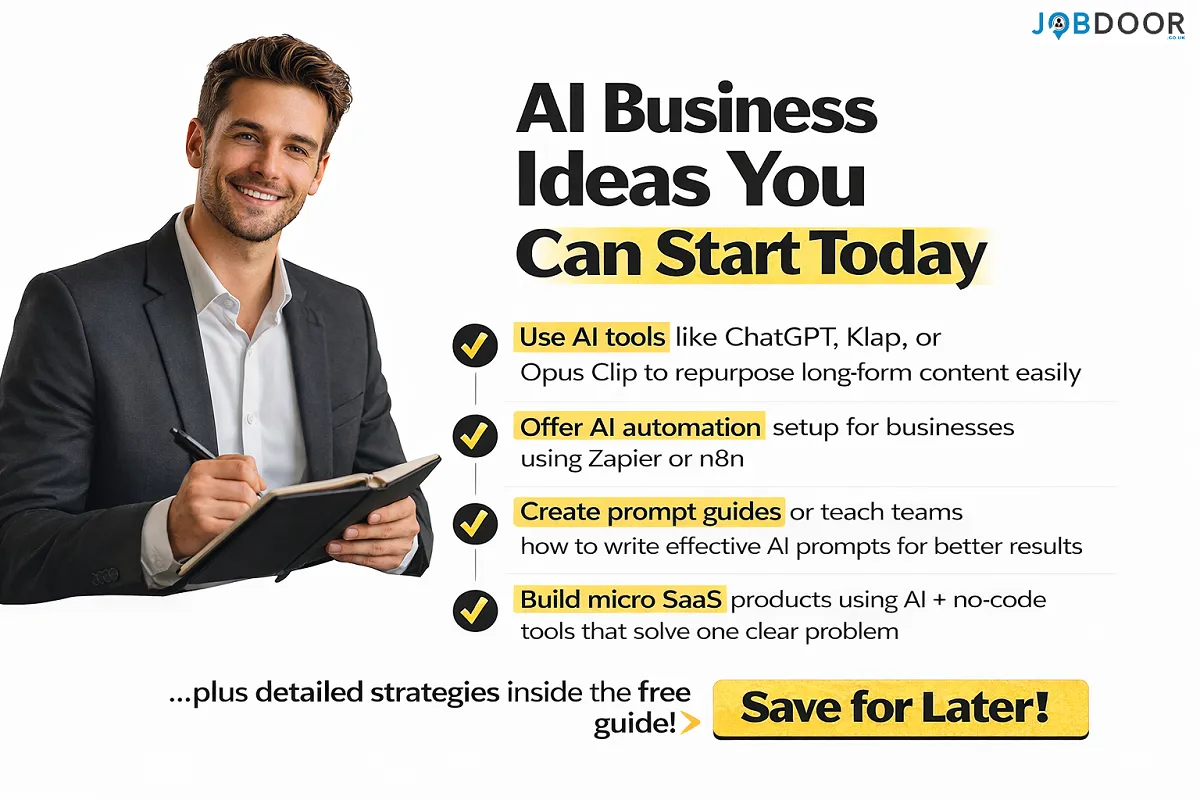
Starting an AI-enabled business does not mean building complicated software or becoming a programmer. For many people, the more practical opportunity is to use AI to deliver a useful service, improve an existing business process, or solve a specific problem for a customer.
The important question is not “What AI business can make me rich?” It is “What problem can I solve better, faster or more consistently with AI?”
This guide focuses on realistic AI business ideas for freelancers, professionals and small-business owners. The goal is to start with a clear service, test demand, build useful skills and improve the offer as you gain experience.
How an AI-Enabled Business Works
A simple model is:
Customer problem → Your expertise → AI-assisted workflow → Useful result
AI is the support layer. Your value comes from understanding the customer, choosing the right process, checking the output and delivering something the customer can actually use.
1. AI-Assisted Content Services
Businesses and creators need blog posts, newsletters, product descriptions, social posts, email campaigns and other content. AI can speed up research, outlining, drafting and repurposing, while you remain responsible for accuracy, editing and the final voice.
Potential customers: small businesses, agencies, consultants, creators and online stores.
Start with one clear offer instead of selling “everything.” For example, you could provide a monthly package of edited blog articles or turn existing long-form content into a set of social posts.
2. Content Repurposing Services
Many businesses already have valuable content but do not have time to reuse it. You can turn a podcast, webinar, video or article into shorter posts, email content, video scripts and other formats.
- Extract useful points from long content
- Create platform-specific drafts
- Prepare captions and short-form scripts
- Organise the content into a publishing plan
The business is not simply “using AI.” You are selling a repeatable content service that saves the client time.
3. AI Research and Information Services
Research is another area where AI can help with summarising information, organising notes, comparing sources and creating first-pass reports. Human verification remains essential, especially when the work involves facts, money, legal matters or important business decisions.
You could offer research support for market research, competitor analysis, industry summaries, customer research or internal knowledge documents.
4. AI Workflow and Automation Services
Small businesses often lose time on repetitive tasks such as moving information between systems, preparing routine emails, organising leads or creating regular reports.
If you understand how business processes work, you can help identify repetitive steps and connect appropriate software. You do not necessarily need to build complex software from scratch.
- Map the current process
- Identify repetitive steps
- Choose suitable automation tools
- Test the workflow
- Document how it works
Good automation work starts with the process, not the tool.
5. AI Training for Teams and Small Businesses
Companies may have access to AI tools but still struggle to use them consistently. A practical training service can focus on everyday work rather than technical theory.
- Writing and editing workflows
- Research and summarisation
- Meeting and documentation workflows
- Data and spreadsheet tasks
- Prompting and task instructions
- AI output review and responsible use
If you offer training, keep examples relevant to the team’s actual jobs. A sales team, HR team and finance team will not have the same needs.
6. AI-Assisted Social Media Services
Small businesses often know they need a social presence but struggle to maintain it. You can combine AI-assisted idea generation and drafting with your own editing, content planning and platform knowledge.
A useful service could include a monthly content calendar, captions, creative briefs, short-video scripts and performance reviews.
7. AI-Assisted Video and Creative Services
AI can support parts of the video production process, including scripts, captions, transcripts, rough edits, audio cleanup, repurposing and creative planning. The human role remains important for storytelling, brand consistency and quality control.
This can work well for businesses that need regular educational videos, social clips, product content or internal training material.
8. AI-Assisted Business Documentation
Businesses create many documents that follow repeatable structures: standard operating procedures, meeting summaries, internal guides, onboarding material, FAQs and process notes.
You can help turn scattered information into clear, organised documentation. AI can assist with structure and drafting, while you check the details and make sure the document reflects the company’s real process.
9. AI-Assisted Data and Reporting Services
Businesses have more data than ever, but raw spreadsheets are not always useful to decision-makers. If you have basic spreadsheet and analytical skills, AI can help with formulas, summaries, categorisation and first-pass analysis.
Your job is to turn the information into a clear report, identify useful patterns and explain what the numbers mean. Always check calculations and important conclusions yourself.
10. Build a Small AI-Powered Digital Product
A digital product can be a template, checklist, workflow guide, prompt collection, spreadsheet, training resource or other useful resource for a specific audience.
The strongest products usually solve a narrow problem. Instead of creating a huge generic AI guide, create something designed for a particular user and task.
Which AI Business Model Is Best for a Beginner?
| Business model | Best starting point | Main skill needed |
|---|---|---|
| AI-assisted services | Freelancers and professionals | Existing professional skill |
| Content repurposing | Creators and marketers | Editing and content judgment |
| Automation | Small businesses | Process thinking |
| AI training | Teams and organisations | Communication and teaching |
| Digital products | People with niche knowledge | Product creation and marketing |
How to Choose One Idea
Do not start five businesses at once. Use a simple filter:
- What skill do I already have? Start from an existing strength where possible.
- What problem do people already pay to solve? Look for a clear business need rather than chasing a trend.
- Can AI improve my delivery? The tool should make the workflow better, not become the entire offer.
- Can I demonstrate the result? Create a sample, before-and-after example or small portfolio.
- Can I deliver it repeatedly? A repeatable process is easier to price and improve.
A Practical 7-Day Test
- Day 1: Choose one customer type and one problem.
- Day 2: Map the work from customer request to final result.
- Day 3: Test where AI can save time or improve the process.
- Day 4: Create one strong sample.
- Day 5: Write a simple service offer with a clear outcome.
- Day 6: Show the offer to potential customers and ask for feedback.
- Day 7: Review the feedback and improve the offer.
How to Price an AI-Assisted Service
Do not base your price only on how quickly AI helps you complete the work. Customers pay for the useful result, your expertise, communication, revisions, reliability and quality control.
Start with a simple scope. Clearly state what is included, how many revisions are allowed, what the customer must provide and when the work will be delivered. Once you understand your delivery time and customer demand, you can adjust your pricing.
Skills That Make AI Business Ideas More Valuable
- Clear communication
- Research and fact-checking
- Editing and quality control
- Problem-solving
- Process design
- Basic data skills
- Customer understanding
- Project management
- Responsible AI use
AI becomes more valuable when combined with a real professional skill. This is why building practical AI skills can support both freelancing and traditional career development.
Important Mistakes to Avoid
- Do not promise guaranteed income. Business results depend on demand, pricing, skill and execution.
- Do not sell raw AI output. Review, edit and improve anything delivered to a customer.
- Do not buy dozens of tools. Start with the smallest stack that solves the problem.
- Do not ignore privacy. Be careful with confidential customer, employee and business information.
- Do not automate everything. Keep human review where accuracy, judgement or customer trust matters.
- Do not chase every new AI trend. A boring problem with a useful solution can be a better business opportunity.
Where to Go Next
If you want to build income around AI, start by strengthening a useful skill rather than collecting tools. Our guide to AI skills that can create career opportunities covers practical areas such as writing, research, data analysis and workflow automation.
You can also see our AI tools for small business guide when you are ready to compare tools for specific business workflows.
For a broader freelance approach, see our guide to building income with AI skills and freelance services. You can also use the 30-day AI skills plan to build a more structured routine.
Frequently Asked Questions
Can I start an AI business without programming?
Yes. Many service-based opportunities involve writing, research, content, training, workflow design or business support. Programming becomes more important when you want to build custom software or advanced technical products.
Do I need expensive AI tools?
No. Start by testing the workflow with a small number of suitable tools. Upgrade only when a paid feature saves meaningful time or improves the service you deliver.
Is an AI business guaranteed to make money?
No. AI can improve how you work, but it does not create automatic demand. You still need a useful offer, customers, good delivery and a sustainable pricing model.
What is the best AI business idea for a beginner?
The best starting point is usually the one that combines a skill you already have with a problem customers already understand. A focused service is often easier to test than a complicated product.
Final Takeaway
You do not need to build the next major AI company to benefit from artificial intelligence. A more realistic starting point is to take a skill you already have, find a clear customer problem and use AI to make the work faster, better or easier to deliver.
Start with one problem, one offer and one repeatable workflow. Test it with real people, improve the service and build your AI skills along the way.










How to Start a Career in Sports and Leisure in the UK
A practical guide to sports and leisure careers in the UK, covering jobs, qualifications, apprenticeships, skills, experience, CVs and career...


How to Start a Career in Travel and Tourism in the UK
Travel and tourism is a broad career sector with opportunities in travel agencies, airports, airlines, visitor attractions, tours, hotels, heritage...


How to Start a Career in Property and Real Estate in the UK
Property and real estate is a broad career field covering residential property, commercial buildings, land, development, valuation, lettings, property management...


How to Start a Career in Hospitality in the UK
Thinking about hospitality as a career in the UK? Compare hotel, restaurant and guest service roles, entry routes, skills, apprenticeships...


How to Start a Career in Retail in the UK
Thinking about a retail career in the UK? Compare retail roles, entry routes, apprenticeships, skills, experience, CV tips and ways...


How to Start a Career in Science and Research in the UK
Planning a science or research career in the UK? Compare career paths, qualifications, apprenticeships, skills and practical ways to get...


How to Start a Career in Law in the UK
Thinking about a career in law? This guide explains UK legal career routes, qualifications, solicitor and barrister pathways, apprenticeships, skills,...


How to Start a Career in Education in the UK
Thinking about a career in education? Compare teaching and non-teaching roles, qualifications, apprenticeships, experience, skills and practical steps for getting...


How to Start a Career in Marketing in the UK
Marketing is a broad career field that combines communication, creativity, research, data and business thinking. It includes traditional marketing as...


How to Start a Career in Healthcare in the UK
Healthcare is one of the UK’s broadest career areas. It includes doctors and nurses, but also healthcare assistants, laboratory staff,...


How to Start a Career in Human Resources (HR) in the UK
Photo by Vitaly Gariev on Unsplash Human resources, usually called HR, is a people-focused career that combines communication, organisation, business...


How to Start a Career in Construction in the UK
Construction is one of the UK’s broadest career sectors. It includes hands-on trades such as bricklaying, carpentry and plumbing, as...


How to Start a Career in Energy and Utilities in the UK
Planning a career in energy and utilities in the UK? See job options, apprenticeships, qualifications, skills and practical steps to...


How to Start a Career in Media and Communications in the UK
Planning a media and communications career in the UK? Compare job options, entry routes, apprenticeships, skills, experience and practical steps...


How to Start a Career in Environmental and Sustainability Jobs in the UK
Environmental and sustainability careers are becoming an important part of many UK workplaces. Jobs in this area can involve protecting...


How to Start a Career in Cybersecurity in the UK
Thinking about a cybersecurity career in the UK? Here is a practical guide to skills, qualifications, entry-level roles, applications and...


How to Start a Career in Engineering in the UK
Thinking about engineering as a career in the UK? Here is a practical guide to engineering fields, qualifications, apprenticeships, skills,...


How to Start a Career in Government and Public Services in the UK
Thinking about a career in government or public services? This guide covers job options, entry routes, apprenticeships, skills, applications and...


Rolls-Royce Internship UK: Eligibility, Opportunities & How to Apply
Find Rolls-Royce internships in the UK with practical guidance on eligibility, opportunities, applications, assessments, skills and preparation.


How to Start a Career in Transport and Logistics in the UK
Planning a career in transport and logistics in the UK? See entry-level roles, apprenticeships, qualifications, skills and practical steps to...
-
 Career3 years ago
Flexible Jobs for Older Adults in the UK: 7 Career Options
-
 How-to8 months ago
How to Use Google Gemini for Freelance Work and Career Skills
-
 Jobs8 months ago
Second Jobs in the UK: 15 Practical Ways to Earn Extra Income
-

 Career2 years ago
Free Job Posting Sites in the UK: Options for Employers
-
 How-to8 months ago
How to Build Passive Income: 20 Income-Producing Assets for Long-Term Financial Growth
-
 AI & Tools8 months ago
How to Use Google Gemini for Productivity at Work
-

 Job Description3 years ago
Support Worker Job Description: Duties, Skills, Salary and Career Guide UK
-
 AI & Tools8 months ago
ChatGPT vs Microsoft Copilot: Which AI Is Best for You?