
AI & Tools
AI and Entry-Level Jobs in the UK: Skills for the Future
See how AI may change entry-level jobs in the UK and which digital, AI and human skills can help graduates and young workers prepare.
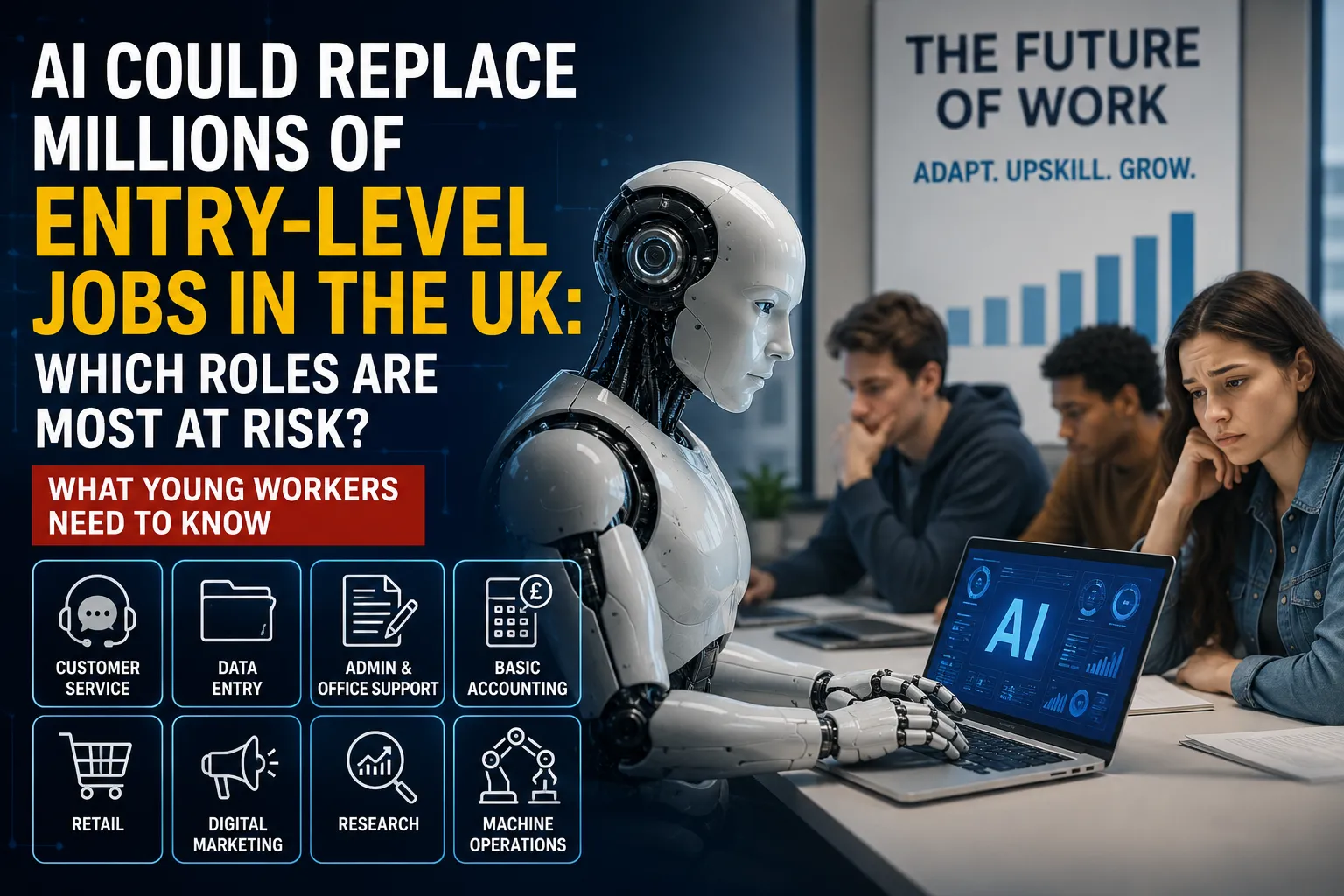
Artificial intelligence is changing entry-level work across many industries. The biggest concern for young workers is not simply whether AI will remove jobs, but whether it will reduce some of the traditional first steps into a career.
Routine tasks such as data entry, basic administration, simple customer queries and repetitive information processing are increasingly supported by software. At the same time, employers still need people who can communicate, solve problems, work with customers and use technology responsibly.
This guide looks at which entry-level tasks may face more automation, what is likely to change rather than disappear, and how job seekers can prepare for a workplace where AI is part of everyday work.
Why Entry-Level Work Is Changing
Entry-level roles often include routine tasks because they give new employees a way to gain experience. A junior worker might begin by preparing documents, updating records, answering common questions or organising information.
AI and automation can now support many of these activities. That means some employers may need fewer people for purely repetitive work, while expecting junior employees to contribute more quickly in areas requiring judgement, communication and problem-solving.
The important distinction is between automating a task and eliminating an entire occupation. Most jobs contain several different types of tasks, and technology may affect those tasks differently.
Entry-Level Areas That May Face More Automation
| Area | Tasks likely to change | Skills that become more valuable |
|---|---|---|
| Administration | Data entry, scheduling, routine documents | Organisation, communication, coordination |
| Customer service | Basic questions and routine requests | Problem-solving, empathy, escalation handling |
| Data processing | Information entry and extraction | Data quality, analysis, spreadsheet skills |
| Marketing | Basic copy, simple content and reporting | Strategy, creativity, audience understanding |
| Finance support | Routine processing and reconciliation | Accuracy, financial understanding, judgement |
| Research support | Basic information gathering and summaries | Source checking, analysis and critical thinking |
1. Administrative and Office Support
Office administration is likely to see continued automation because many tasks follow predictable processes. Software can help schedule meetings, organise documents, process information and prepare routine drafts.
That does not make administrative experience worthless. It changes the type of contribution that may be valuable. Employers may increasingly look for people who can coordinate work, communicate with teams, manage exceptions and keep processes running when something goes wrong.
2. Customer Service
AI assistants can handle many straightforward customer questions, such as order information, opening hours, account guidance and basic troubleshooting.
Human support remains important when a problem is unusual, sensitive or complicated. Entry-level customer service workers can therefore strengthen their prospects by developing communication, conflict handling, product knowledge and problem-solving skills rather than relying only on scripted responses.
3. Data Entry and Routine Processing
Data entry is particularly exposed when the work involves moving information between systems or extracting details from standard documents.
Workers can make themselves more useful by moving beyond simple entry work and developing spreadsheet skills, data checking, reporting and basic analysis. Understanding why the data matters is often more valuable than simply entering it.
4. Basic Content and Marketing Tasks
AI can help produce first drafts, social media ideas, advertising variations and basic reports. This may reduce demand for work based entirely on repetitive content production.
Marketing professionals still need to understand customers, brand positioning, campaign goals and business results. A junior marketer who can use AI while also thinking strategically may be more useful than someone who can only produce large amounts of basic content.
5. Routine Finance and Accounting Support
Financial software can automate parts of invoice processing, expense tracking, reconciliation and reporting. These changes may affect some junior tasks without removing the need for accountants and finance professionals.
Accuracy, financial knowledge, regulation, interpretation and professional judgement remain important. Building these skills can help new workers move beyond purely repetitive financial processing.
6. Research and Information Processing
AI can summarise documents, organise notes and help people process large amounts of information. This can change junior research roles where the main responsibility was collecting and summarising information.
However, good research involves more than producing a summary. Workers need to evaluate sources, identify weak evidence, understand context and explain what information means. These skills become especially important when AI-generated information must be checked.
Are Entry-Level Jobs Going to Disappear?
No. It is too simplistic to say that AI will eliminate entry-level employment altogether.
Some jobs may shrink, some will change and new roles may appear. Businesses will also continue to need people to manage customers, operate systems, solve problems, coordinate teams and handle situations that cannot be reduced to a predictable process.
The bigger issue is that the starting point for some careers may change. A role that once involved six hours of routine work and two hours of judgement may eventually involve less routine work and more responsibility from the beginning.
The Entry-Level Experience Problem
One of the most important questions is how people will gain experience if businesses automate many basic tasks.
Traditionally, a person could start with routine responsibilities, learn the workplace and gradually take on harder work. If some of those tasks disappear, employers may expect candidates to arrive with more practical experience than before.
That makes alternative forms of evidence more useful. Students and career changers can build experience through internships, volunteering, freelance projects, portfolios, apprenticeships, university projects and other genuine opportunities connected to their target field.
Skills That Can Help You Work Alongside AI
Young workers do not need to become AI engineers to prepare for this change. A useful combination is basic AI literacy plus strong professional skills.
- AI literacy: Know what AI tools can and cannot do.
- Critical thinking: Check information instead of accepting AI output automatically.
- Communication: Explain ideas clearly to colleagues and customers.
- Problem-solving: Handle situations that do not follow a simple script.
- Data skills: Understand spreadsheets, reports and basic analysis.
- Digital skills: Work confidently with common workplace systems.
- Adaptability: Be prepared to update your skills as tools and processes change.
For a broader view of the skills employers may value as AI changes work, see our guide to AI skills for job seekers.
How to Prepare for an AI-Changed Job Market
- Choose a target career area. Do not try to prepare for every possible future job.
- Study current job descriptions. Look for skills that appear across several employers.
- Identify the routine tasks. Consider which parts of the job technology may change.
- Build the human and technical skills around them. Develop abilities that help you supervise, interpret or improve technology-supported work.
- Create practical evidence. Use projects, portfolios or genuine work experience to demonstrate your skills.
- Practise using AI responsibly. Use approved tools for suitable tasks and check important outputs.
- Keep updating your skills. Treat employability as an ongoing process rather than a one-time qualification.
How AI Can Become an Advantage for New Workers
AI is not only a threat to entry-level work. It can also help new employees become productive faster.
A junior worker may use an approved AI tool to organise research, create a first draft, explain a spreadsheet formula or prepare questions before a meeting. The worker still needs to check the output and understand the task.
This creates a useful career mindset: use AI to increase your capability, not to replace your responsibility.
Our guide on using AI efficiently at work explains how to build practical workflows around this approach.
What Employers May Look for in Future Entry-Level Candidates
| Old hiring signal | Stronger future signal |
|---|---|
| Can perform repetitive tasks | Can improve and manage a workflow |
| Knows one software tool | Can adapt to new digital tools |
| Can produce basic content | Can understand the audience and improve the output |
| Can follow a script | Can handle exceptions and customer needs |
| Has completed a course | Can demonstrate practical results |
Common Mistakes Job Seekers Should Avoid
- Assuming AI will eliminate every job in their chosen field.
- Ignoring AI because they believe it is only relevant to technical careers.
- Learning tools without understanding the underlying job or industry.
- Relying on AI-generated applications without personalising or checking them.
- Claiming AI expertise without being able to explain a real use case.
- Focusing only on technical skills and neglecting communication and judgement.
- Waiting for a perfect opportunity instead of building relevant experience.
Frequently Asked Questions
Will AI remove all entry-level jobs in the UK?
No. AI is more likely to change the tasks within many jobs than eliminate every entry-level position. The impact will vary by occupation and employer.
Which entry-level tasks are most exposed to automation?
Highly repetitive, predictable tasks such as basic data entry, routine document processing, simple information retrieval and some scripted customer interactions are more exposed.
How can graduates prepare for AI?
Build practical digital and AI literacy alongside communication, critical thinking, problem-solving and industry-specific knowledge. Create evidence through projects, internships or other genuine experience.
Do I need to learn programming to stay employable?
Not necessarily. Programming is valuable for some careers, but many roles benefit more from AI literacy, data skills, communication, problem-solving and knowledge of the industry.
Can AI help me get an entry-level job?
It can support research, CV preparation, interview practice and skill development, but your applications should remain truthful and your final work should reflect your own experience.
Related JobDoor Guides
- AI Skills Every Job Seeker Should Learn
- How AI Is Changing Recruitment
- How to Use AI Responsibly When Applying for Jobs
- Entry-Level Jobs in the UK Compared
- Entry-Level Jobs in the UK for People With Little or No Experience
Final Thoughts
AI may make some traditional entry-level tasks less common, but that does not mean young people will have no route into employment. The bigger change is that employers may expect new workers to bring more than the ability to complete repetitive tasks.
Build AI literacy, digital confidence and strong human skills. Look for practical ways to gain experience and focus on becoming someone who can use technology while still applying judgement and responsibility.
The goal is not to compete with AI on repetitive work. It is to become better at the work that technology cannot handle on its own.









How to Start a Career in Sports and Leisure in the UK
A practical guide to sports and leisure careers in the UK, covering jobs, qualifications, apprenticeships, skills, experience, CVs and career...


How to Start a Career in Travel and Tourism in the UK
Travel and tourism is a broad career sector with opportunities in travel agencies, airports, airlines, visitor attractions, tours, hotels, heritage...


How to Start a Career in Property and Real Estate in the UK
Property and real estate is a broad career field covering residential property, commercial buildings, land, development, valuation, lettings, property management...


How to Start a Career in Hospitality in the UK
Thinking about hospitality as a career in the UK? Compare hotel, restaurant and guest service roles, entry routes, skills, apprenticeships...


How to Start a Career in Retail in the UK
Thinking about a retail career in the UK? Compare retail roles, entry routes, apprenticeships, skills, experience, CV tips and ways...


How to Start a Career in Science and Research in the UK
Planning a science or research career in the UK? Compare career paths, qualifications, apprenticeships, skills and practical ways to get...


How to Start a Career in Law in the UK
Thinking about a career in law? This guide explains UK legal career routes, qualifications, solicitor and barrister pathways, apprenticeships, skills,...


How to Start a Career in Education in the UK
Thinking about a career in education? Compare teaching and non-teaching roles, qualifications, apprenticeships, experience, skills and practical steps for getting...


How to Start a Career in Marketing in the UK
Marketing is a broad career field that combines communication, creativity, research, data and business thinking. It includes traditional marketing as...


How to Start a Career in Healthcare in the UK
Healthcare is one of the UK’s broadest career areas. It includes doctors and nurses, but also healthcare assistants, laboratory staff,...


How to Start a Career in Human Resources (HR) in the UK
Photo by Vitaly Gariev on Unsplash Human resources, usually called HR, is a people-focused career that combines communication, organisation, business...


How to Start a Career in Construction in the UK
Construction is one of the UK’s broadest career sectors. It includes hands-on trades such as bricklaying, carpentry and plumbing, as...


How to Start a Career in Energy and Utilities in the UK
Planning a career in energy and utilities in the UK? See job options, apprenticeships, qualifications, skills and practical steps to...


How to Start a Career in Media and Communications in the UK
Planning a media and communications career in the UK? Compare job options, entry routes, apprenticeships, skills, experience and practical steps...


How to Start a Career in Environmental and Sustainability Jobs in the UK
Environmental and sustainability careers are becoming an important part of many UK workplaces. Jobs in this area can involve protecting...


How to Start a Career in Cybersecurity in the UK
Thinking about a cybersecurity career in the UK? Here is a practical guide to skills, qualifications, entry-level roles, applications and...


How to Start a Career in Engineering in the UK
Thinking about engineering as a career in the UK? Here is a practical guide to engineering fields, qualifications, apprenticeships, skills,...


How to Start a Career in Government and Public Services in the UK
Thinking about a career in government or public services? This guide covers job options, entry routes, apprenticeships, skills, applications and...


Rolls-Royce Internship UK: Eligibility, Opportunities & How to Apply
Find Rolls-Royce internships in the UK with practical guidance on eligibility, opportunities, applications, assessments, skills and preparation.


How to Start a Career in Transport and Logistics in the UK
Planning a career in transport and logistics in the UK? See entry-level roles, apprenticeships, qualifications, skills and practical steps to...
-
 Career3 years ago
Flexible Jobs for Older Adults in the UK: 7 Career Options
-
 How-to8 months ago
How to Use Google Gemini for Freelance Work and Career Skills
-
 Jobs8 months ago
Second Jobs in the UK: 15 Practical Ways to Earn Extra Income
-

 Career2 years ago
Free Job Posting Sites in the UK: Options for Employers
-
 How-to8 months ago
How to Build Passive Income: 20 Income-Producing Assets for Long-Term Financial Growth
-

 AI & Tools8 months ago
How to Use Google Gemini for Productivity at Work
-

 Job Description3 years ago
Support Worker Job Description: Duties, Skills, Salary and Career Guide UK
-

 AI & Tools8 months ago
ChatGPT vs Microsoft Copilot: Which AI Is Best for You?