
AI & Tools
How to Choose AI Tools for Work: A Practical Task-Based Guide
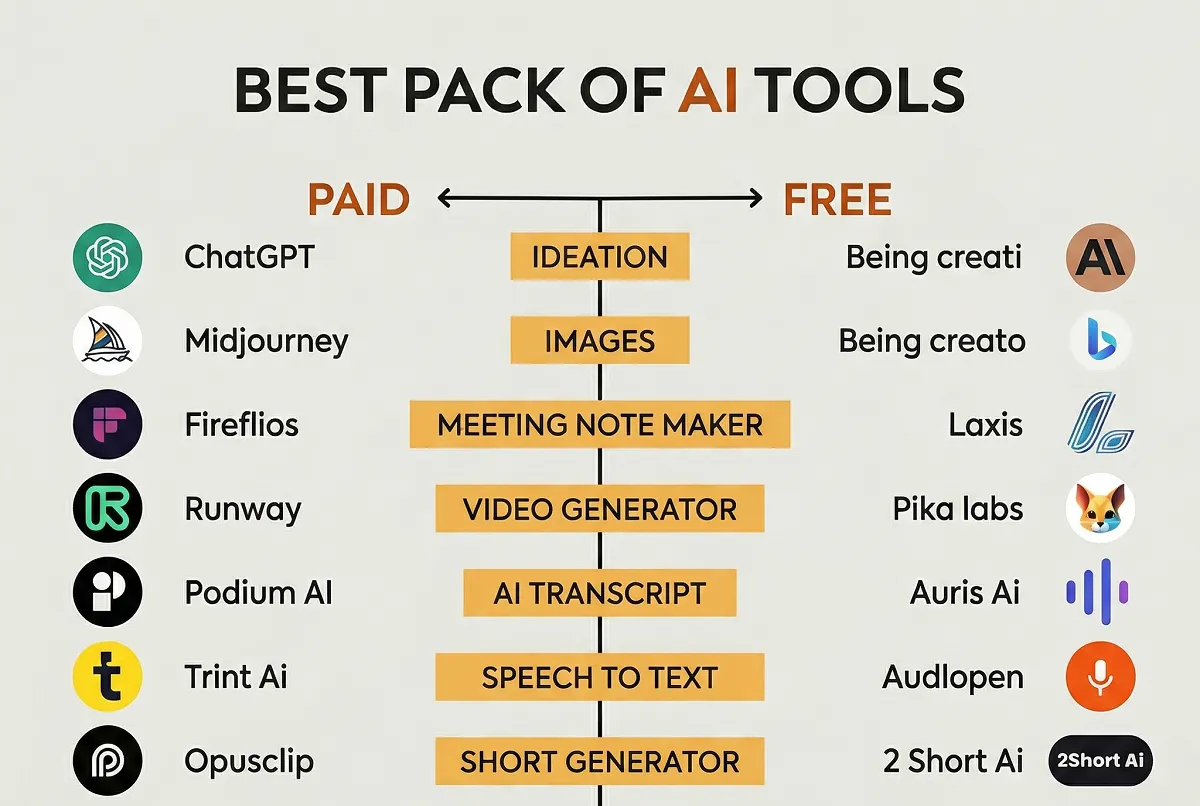
Choosing an AI tool for work can feel harder than using one. New services appear constantly, many tools offer similar features, and a product that works well for one person may be a poor fit for another.
The smarter approach is to start with the task you need to complete. Then compare tools based on output quality, workflow fit, privacy, cost and the amount of human review required.
This guide shows how to choose AI tools for common workplace and career tasks without building an unnecessarily complicated collection of subscriptions.
Why You Should Choose AI Tools by Task
An AI tool is useful when it solves a real problem. Its popularity, number of features or position on a “best AI tools” list does not automatically make it suitable for your work.
For example, you might need AI to:
- Draft or edit workplace writing
- Research a topic
- Summarise long documents
- Prepare a presentation
- Analyse information or spreadsheets
- Take meeting notes
- Write or review code
- Automate repetitive steps
- Prepare for a job application or interview
Each task has different requirements. Start there rather than starting with a product name.
The 8 Questions to Ask Before Choosing an AI Tool
1. What exact task am I trying to improve?
Be specific. “I want to use AI” is not a useful goal. “I spend two hours preparing weekly reports” gives you something you can test.
2. What would a good result look like?
Define the standard before testing the tool. This prevents an impressive-looking demo from being mistaken for a genuinely useful result.
3. How much editing will the output need?
A tool that produces a quick draft but requires heavy correction may save less time than expected.
4. Does it fit my existing software?
Integration with the applications you already use can matter more than a small difference in AI output quality.
5. What information does it need?
Consider whether you will need to upload company documents, customer information, personal data or other sensitive material.
6. Is the free version enough?
If you use a tool occasionally, paying for advanced features may not make sense.
7. Does it save enough time to justify the cost?
Measure the time saved after including checking and editing. A subscription is worthwhile only when the improvement is meaningful.
8. Can another tool already do this?
Before adding another service, check the AI features available in tools you already use.
AI Tools by Work Task
Writing, Editing and Workplace Communication
General AI assistants can help with emails, reports, outlines, rewriting, brainstorming and other first-draft work.
Best fit when: You regularly create or revise text.
What to test: Accuracy, tone, instruction-following, context retention and how much editing is needed.
For job seekers, AI can also support application writing, but the final CV or cover letter should remain accurate and reflect your real experience.
Research and Source-Based Work
Research-focused AI can help organise information, summarise material and locate relevant sources.
Best fit when: You spend significant time gathering and comparing information.
What to test: Source quality, citation support, freshness of information and ease of verification.
Never treat an AI-generated answer as proof simply because it includes a source. Open and check important sources yourself.
Long Documents and Knowledge Work
Document-focused AI can help summarise reports, compare information and answer questions about material you provide.
Best fit when: Your work involves contracts, reports, research papers, policies, meeting documents or large collections of notes.
What to test: Whether important details are missed, how accurately the tool handles context and whether its summaries preserve the meaning of the original document.
Meetings and Notes
AI meeting assistants can transcribe conversations, summarise discussions and create action lists.
Best fit when: You attend frequent online meetings and spend time preparing or cleaning up notes.
What to test: Transcription accuracy, speaker identification, action-item quality and privacy controls.
Check company policy and participant requirements before recording or processing a meeting.
Presentations and Visual Communication
AI presentation tools can turn an outline into a starting structure for slides, reports or visual documents.
Best fit when: You regularly create presentations for clients, managers, training sessions or interviews.
What to test: Logical structure, readability, visual consistency and how easily you can edit the final presentation.
Data and Spreadsheet Analysis
AI can help explain datasets, suggest formulas, identify patterns and assist with routine analysis.
Best fit when: You work with spreadsheets or structured data but spend too much time on repetitive analysis.
What to test: Calculation accuracy, formula correctness, handling of missing data and whether results can be independently checked.
Important financial, operational or business decisions should not rely on unchecked AI-generated calculations.
Coding and Software Development
AI coding assistants can help generate routine code, explain unfamiliar code, suggest fixes and prepare documentation.
Best fit when: You are a developer or regularly work with technical systems.
What to test: Code accuracy, security, compatibility with your project and how much review is required.
Always test generated code before using it in production.
Design, Image and Creative Work
AI design tools can help generate concepts, resize or edit assets, create early visual ideas and speed up repetitive creative work.
Best fit when: You work in marketing, design, content or communications.
What to test: Output quality, editing control, brand consistency, licensing terms and whether the tool fits your existing design process.
Video and Audio Production
AI video and audio tools can assist with transcription, captions, editing, voice work, background cleanup and content repurposing.
Best fit when: You produce regular video, audio or training content.
What to test: Editing quality, transcription accuracy, export options and the amount of manual correction required.
Automation and Repetitive Workflows
AI automation tools can connect applications and reduce repetitive actions such as moving information, creating notifications or preparing routine reports.
Best fit when: A task happens repeatedly and follows a reasonably predictable process.
What to test: Reliability, error handling, integrations, permissions and the ability to stop or review automated actions.
Do not automate a broken process. Fix the process first, then automate the repetitive parts.
Job Search and Career Development
Job seekers can use AI for job-description analysis, CV editing, interview practice, employer research and identifying transferable skills.
Best fit when: You need help organising a large job search or preparing for specific applications.
What to test: Whether the tool keeps your information accurate, produces natural wording and helps you prepare rather than simply writing everything for you.
Job seekers can also read our guides on AI skills for job seekers and responsible AI use in job applications.
A Simple AI Tool Selection Matrix
| Task | Tool type | Main thing to compare |
|---|---|---|
| Writing | General AI assistant | Quality and editing time |
| Research | Research assistant | Sources and verification |
| Documents | Document AI | Context handling |
| Meetings | Meeting assistant | Accuracy and privacy |
| Presentations | Presentation AI | Structure and editability |
| Data | Data/spreadsheet AI | Calculation accuracy |
| Coding | Coding assistant | Code quality and security |
| Automation | Workflow automation | Reliability and integrations |
One General AI Tool or Several Specialist Tools?
For many professionals, one capable general AI assistant is enough to start. Specialist tools become useful when a particular workflow requires features that a general assistant does not provide.
A practical setup might look like this:
- General assistant: writing, brainstorming and everyday questions
- Research tool: source-heavy research when required
- Workplace AI: features built into your existing office software
- Specialist tool: coding, design, video or automation when your role requires it
This approach reduces tool switching and makes it easier to understand which services are actually valuable.
How to Test an AI Tool Properly
Do not choose an AI service because its website looks impressive. Test it against a real task.
- Pick a repeated task. Choose something you perform at least a few times.
- Record your current time. Measure how long the task normally takes.
- Define the quality standard. Decide what the final result must contain.
- Run the AI test. Give it realistic instructions and information.
- Check the output. Record errors, missing information and editing time.
- Compare the result. Look at time, quality and effort rather than speed alone.
- Repeat the test. One successful result is not enough to prove a workflow works consistently.
How to Measure AI Tool ROI
AI productivity is not simply “the tool generated something quickly.” Calculate the full workflow.
Practical time saved = normal task time − AI-assisted task time
Then consider the subscription cost and the value of the time saved.
| Measure | Question |
|---|---|
| Time | Did the task actually become faster? |
| Quality | Is the final result at least as good? |
| Editing | How much correction is needed? |
| Cost | Is the improvement worth the subscription? |
| Reliability | Does the tool perform consistently? |
| Risk | Could incorrect output create a serious problem? |
Free vs Paid AI Tools
Free access is often enough for occasional use and testing. A paid plan can make sense when you use a tool regularly and its additional limits, features or integrations produce measurable value.
Before paying, ask:
- How often will I use it?
- What feature am I actually paying for?
- Could an existing tool do the same job?
- How much time does it save each month?
- Can I cancel easily if the value disappears?
Our guide to paid vs free AI tools covers this decision in more detail.
Privacy and Workplace Data
Tool selection should include data handling, especially when AI is used at work.
- Follow your employer’s AI policy.
- Do not upload passwords or unnecessary personal information.
- Be careful with customer and employee data.
- Check the service’s current privacy and retention settings.
- Use approved business tools for sensitive information when required.
A tool that produces excellent output is still a poor choice if you cannot use it safely for the information involved.
Common AI Tool Selection Mistakes
Choosing the most popular tool
Popularity is not the same as suitability. Test against your own workflow.
Buying too many subscriptions
Several overlapping tools can create extra cost and unnecessary switching.
Comparing features instead of outcomes
A long feature list matters less than whether the tool improves your actual work.
Ignoring human review
AI output may contain factual, calculation, reasoning or formatting errors. Build checking into the workflow.
Using AI where it adds no value
If a task takes two minutes manually and five minutes to check after AI assistance, the AI workflow is not an improvement.
How AI Tool Choice Changes by Career Stage
Students and graduates
Focus on affordable tools that help with research, writing practice, presentations and career preparation without replacing your own thinking.
Job seekers
Prioritise tools that help analyse job descriptions, improve applications, practise interviews and organise your search.
Early-career professionals
Look for tools that reduce repetitive administration and help you communicate, research and prepare workplace documents.
Managers
Focus on reliable workflows, team permissions, privacy and tools that help with reporting, meetings and information management.
Freelancers and small businesses
Prioritise tools that save time on repeated client, marketing, research, content and administrative tasks. Measure the return before adding more subscriptions.
Build Your AI Toolkit Gradually
A practical AI toolkit does not need to contain dozens of products.
- Choose one repeated task.
- Test one suitable AI tool.
- Measure the result for a few uses.
- Document the workflow if it works.
- Keep the tool if it creates clear value.
- Add another specialist tool only when a genuine gap appears.
This task-first approach is more sustainable than chasing every new AI launch.
Frequently Asked Questions
What is the best AI tool for work?
There is no universal winner. The best option depends on the task, your existing software, budget, privacy requirements and the quality of the result.
How many AI tools should I use?
Use as few as necessary. Start with one general assistant and add specialist tools only when they provide a clear advantage.
Are free AI tools good enough?
They can be. Free plans are useful for testing and occasional work. Upgrade when a paid feature or higher limit solves a repeated problem.
Should I use AI for job applications?
Yes, when used responsibly. AI can support research, editing and preparation, but it should not invent qualifications or replace your own judgement.
How do I know if an AI tool is worth paying for?
Test it on real work and compare the full time, quality, editing effort, cost and risk with your current method.
Related JobDoor Guides
- AI Tools for Work: Practical Options for Different Career Tasks
- How to Choose a ChatGPT Alternative for Work
- ChatGPT vs Microsoft Copilot
- How to Use AI Efficiently at Work
- AI Tools for Small Business
Final Thoughts
Choosing AI tools for work does not need to become a search for the biggest or newest AI collection. Start with a real task, define the result you need and test a small number of suitable options.
The strongest long-term skill is not knowing every AI product. It is knowing how to identify useful technology, build it into a workflow, verify the result and measure whether it actually improves your work.










How to Start a Career in Sports and Leisure in the UK
A practical guide to sports and leisure careers in the UK, covering jobs, qualifications, apprenticeships, skills, experience, CVs and career...


How to Start a Career in Travel and Tourism in the UK
Travel and tourism is a broad career sector with opportunities in travel agencies, airports, airlines, visitor attractions, tours, hotels, heritage...


How to Start a Career in Property and Real Estate in the UK
Property and real estate is a broad career field covering residential property, commercial buildings, land, development, valuation, lettings, property management...


How to Start a Career in Hospitality in the UK
Thinking about hospitality as a career in the UK? Compare hotel, restaurant and guest service roles, entry routes, skills, apprenticeships...


How to Start a Career in Retail in the UK
Thinking about a retail career in the UK? Compare retail roles, entry routes, apprenticeships, skills, experience, CV tips and ways...


How to Start a Career in Science and Research in the UK
Planning a science or research career in the UK? Compare career paths, qualifications, apprenticeships, skills and practical ways to get...


How to Start a Career in Law in the UK
Thinking about a career in law? This guide explains UK legal career routes, qualifications, solicitor and barrister pathways, apprenticeships, skills,...


How to Start a Career in Education in the UK
Thinking about a career in education? Compare teaching and non-teaching roles, qualifications, apprenticeships, experience, skills and practical steps for getting...


How to Start a Career in Marketing in the UK
Marketing is a broad career field that combines communication, creativity, research, data and business thinking. It includes traditional marketing as...


How to Start a Career in Healthcare in the UK
Healthcare is one of the UK’s broadest career areas. It includes doctors and nurses, but also healthcare assistants, laboratory staff,...


How to Start a Career in Human Resources (HR) in the UK
Photo by Vitaly Gariev on Unsplash Human resources, usually called HR, is a people-focused career that combines communication, organisation, business...


How to Start a Career in Construction in the UK
Construction is one of the UK’s broadest career sectors. It includes hands-on trades such as bricklaying, carpentry and plumbing, as...


How to Start a Career in Energy and Utilities in the UK
Planning a career in energy and utilities in the UK? See job options, apprenticeships, qualifications, skills and practical steps to...


How to Start a Career in Media and Communications in the UK
Planning a media and communications career in the UK? Compare job options, entry routes, apprenticeships, skills, experience and practical steps...


How to Start a Career in Environmental and Sustainability Jobs in the UK
Environmental and sustainability careers are becoming an important part of many UK workplaces. Jobs in this area can involve protecting...


How to Start a Career in Cybersecurity in the UK
Thinking about a cybersecurity career in the UK? Here is a practical guide to skills, qualifications, entry-level roles, applications and...


How to Start a Career in Engineering in the UK
Thinking about engineering as a career in the UK? Here is a practical guide to engineering fields, qualifications, apprenticeships, skills,...


How to Start a Career in Government and Public Services in the UK
Thinking about a career in government or public services? This guide covers job options, entry routes, apprenticeships, skills, applications and...


Rolls-Royce Internship UK: Eligibility, Opportunities & How to Apply
Find Rolls-Royce internships in the UK with practical guidance on eligibility, opportunities, applications, assessments, skills and preparation.


How to Start a Career in Transport and Logistics in the UK
Planning a career in transport and logistics in the UK? See entry-level roles, apprenticeships, qualifications, skills and practical steps to...
-
 Career3 years ago
Flexible Jobs for Older Adults in the UK: 7 Career Options
-
 How-to8 months ago
How to Use Google Gemini for Freelance Work and Career Skills
-
 Jobs8 months ago
Second Jobs in the UK: 15 Practical Ways to Earn Extra Income
-

 Career2 years ago
Free Job Posting Sites in the UK: Options for Employers
-
 How-to8 months ago
How to Build Passive Income: 20 Income-Producing Assets for Long-Term Financial Growth
-

 AI & Tools8 months ago
How to Use Google Gemini for Productivity at Work
-

 Job Description3 years ago
Support Worker Job Description: Duties, Skills, Salary and Career Guide UK
-

 AI & Tools8 months ago
ChatGPT vs Microsoft Copilot: Which AI Is Best for You?