
AI & Tools
AI Productivity at Work: How to Choose Tools That Save Time
Improve workplace productivity with AI. This practical guide explains how to choose AI tools, build useful workflows, save time and use AI responsibly.
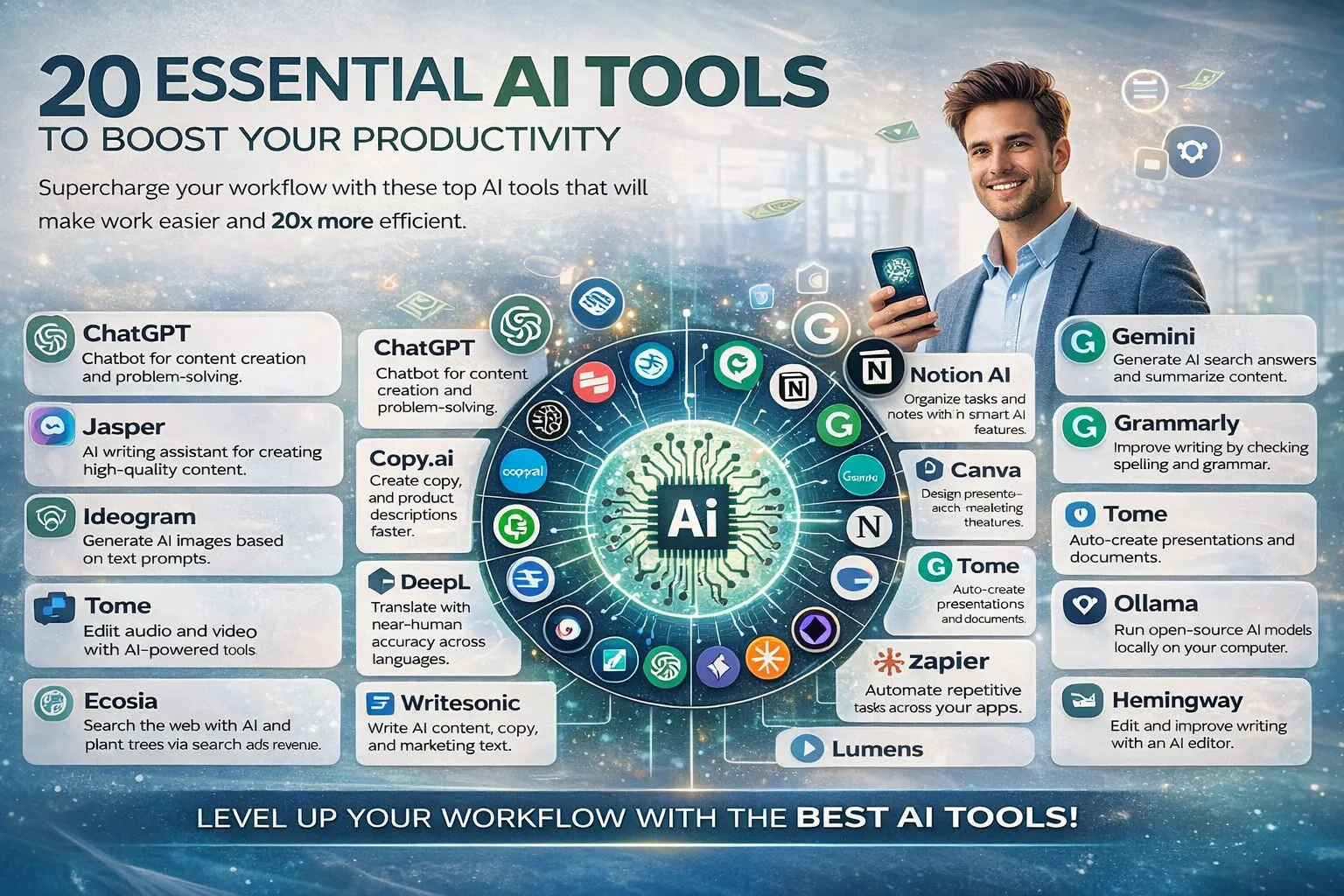
AI Productivity at Work: How to Choose Tools That Save Time
AI productivity is not about collecting dozens of applications. The real benefit comes from using the right technology for the right task while keeping human judgment in the workflow.
For employees, managers and job seekers, the useful question is not “Which AI tool is the most popular?” It is “Which part of my work can AI help me complete more efficiently without reducing quality?”
What AI Productivity Means at Work
AI productivity means using artificial intelligence to support tasks such as writing, research, communication, documentation, data analysis, creative work and repetitive processes.
A good AI workflow should save time or improve quality without creating more checking, correction or security problems than it solves.
| Work problem | AI can help with | Human role |
|---|---|---|
| Too much writing | Drafts, summaries and editing | Accuracy, tone and final approval |
| Information overload | Organisation and summarisation | Source checking and interpretation |
| Repetitive administration | Automation and data handling | Process design and oversight |
| Meeting follow-up | Notes and action lists | Confirm decisions and responsibilities |
| Data-heavy work | Formula help and pattern analysis | Business context and decisions |
| Creative production | Ideas, drafts and visual concepts | Strategy, quality and originality |
Why More AI Tools Do Not Always Mean More Productivity
Signing up for every new AI service can create fragmented workflows, duplicated subscriptions and more time spent learning software.
A smaller toolkit is often better. Choose tools based on recurring work problems, ease of use, reliability, privacy and measurable value.
7 Types of AI Tools That Can Improve Work
1. AI Writing and Editing Tools
Writing assistants can help create first drafts, rewrite unclear sentences, summarise information and adjust tone.
They can support emails, reports, proposals, customer messages, content planning and other routine writing. Your professional judgment should determine the final version.
2. AI Research and Information Tools
Research assistants can help organise questions, compare information and summarise material. They are useful when you need to build an initial understanding of a topic quickly.
For important work, verify claims against reliable sources. AI-generated research should be a starting point, not an automatic substitute for checking evidence.
3. AI Meeting and Documentation Tools
Approved AI meeting tools can help organise notes, summaries and action items. Documentation assistants can also turn rough information into structured internal guides.
Always check company rules before processing meetings or confidential documents with an AI service.
4. AI Data and Spreadsheet Tools
AI can explain spreadsheet formulas, suggest analysis methods, identify possible patterns and help users understand unfamiliar data.
Review calculations, source data and assumptions before using AI-assisted analysis for business decisions.
5. AI Design and Content Tools
AI can support presentations, visual concepts, images, video ideas and content repurposing. This can reduce the amount of time spent creating a first version.
Human input remains essential for brand consistency, audience understanding, accessibility and quality.
6. AI Coding and Technical Tools
Developers can use AI for code suggestions, debugging, testing, documentation and explaining unfamiliar code.
AI-generated code still needs testing, security review and engineering judgment. Faster code production is not useful if it creates fragile or unsafe software.
7. AI Automation Tools
Automation platforms can connect approved applications and reduce repetitive work such as sorting information, preparing routine messages or moving data between systems.
Start with predictable, low-risk processes that are easy to check. Avoid automating critical decisions simply because a workflow is technically possible.
How to Choose an AI Tool for Your Job
Before adopting a tool, ask:
- What task am I improving?
- How often does the task happen?
- How much time does it currently take?
- Can I easily check the AI output?
- Is the information safe to use with this service?
- Does my employer permit the tool?
- Will the tool provide enough value to justify its cost?
A Simple AI Productivity Workflow
Use this six-step process before adding AI to a regular task:
- Identify: Find a repetitive or time-consuming task.
- Define: Decide what a successful result looks like.
- Assist: Give AI the relevant context and ask for a useful first output.
- Review: Check facts, logic, tone and missing information.
- Refine: Improve the result using your professional knowledge.
- Measure: Compare time, quality and correction effort with your previous process.
Examples of AI Workflows That Save Time
Email Workflow
Give an AI assistant your key points and ask for a concise draft. Review the message, add missing context and make sure the tone is appropriate before sending it.
Research Workflow
Start by defining the question. Use AI to organise possible subtopics and summarise relevant information, then verify important claims and record reliable sources.
Meeting Workflow
Where approved tools are available, use AI to organise notes into decisions, action items and owners. Check the summary against the actual meeting before sharing it.
Report Workflow
Use AI to turn rough notes into an outline, then develop each section with your own evidence and expertise. Use AI again for editing and clarity checks rather than treating the first draft as finished.
Administrative Workflow
Identify repetitive steps such as sorting requests or preparing standard information. Test a small automation, add human checks and measure whether it genuinely reduces workload.
How to Measure AI Productivity
Do not judge a tool by how impressive its demo looks. Measure what happens in your actual work.
| Measure | Question to ask |
|---|---|
| Time saved | Does the task take less time? |
| Quality | Is the final work as good or better? |
| Correction time | How much editing does the AI output require? |
| Consistency | Does the workflow produce reliable results? |
| Cost | Does the value justify the subscription or setup? |
AI Privacy and Workplace Security
Productivity should never come at the expense of data security. Before using an AI service, check whether you are allowed to enter the information involved.
- Do not share passwords or access credentials.
- Be careful with customer and employee personal information.
- Do not upload confidential company documents unless the service is approved.
- Follow your employer’s AI and data-handling policies.
- Use human review for sensitive or high-impact decisions.
Common AI Productivity Mistakes
- Trying too many tools at once
- Choosing tools because they are trending
- Copying AI output without checking it
- Ignoring privacy requirements
- Automating a poorly designed process
- Measuring activity instead of actual time or quality improvements
- Assuming AI understands company context automatically
- Using AI where professional judgment is required
AI Productivity Skills That Help Your Career
The most useful long-term skill is not memorising a list of tool names. It is knowing how to improve a workflow with AI.
- Writing clear AI instructions
- Breaking complex work into manageable steps
- Checking AI-generated information
- Editing and improving AI output
- Recognising suitable automation opportunities
- Understanding privacy and responsible AI use
- Combining AI with your existing professional expertise
These skills can transfer across employers and tools as technology changes.
How Job Seekers Can Demonstrate AI Productivity Skills
If you use AI in a portfolio project, freelance task or previous role, focus on the workflow and result rather than simply listing a tool.
For example, explain that you used AI-assisted research to organise information, AI-assisted editing to improve a report or automation to reduce repetitive administration. Be honest about what you did yourself and what AI supported.
Frequently Asked Questions
Does AI really make people more productive?
It can, but the result depends on the task and workflow. A useful AI process should reduce effort or improve quality without creating excessive checking and correction work.
How many AI tools should I use?
There is no ideal number. Start with a small toolkit that solves real problems and add tools only when they provide clear value.
What is the best AI tool for work?
There is no universal best tool. The right choice depends on your role, task, workplace policies, privacy requirements, budget and desired outcome.
Can AI productivity skills help me get a job?
Yes. AI literacy can strengthen your existing professional skills, especially when you can show practical examples of using AI responsibly to improve work.
Should AI replace human decision-making?
No. AI can support analysis and routine tasks, but people should remain responsible for important decisions, especially when accuracy, safety, privacy or fairness matters.
Related JobDoor Guides
- AI Basics for Work
- AI Tools for Work: A Beginner’s Guide
- How to Choose AI Tools for Work
- How to Use AI Efficiently at Work
- AI Skills Every Job Seeker Should Learn
Final Thoughts
AI productivity is strongest when it is connected to a real workplace problem. You do not need dozens of applications. Choose a task, test one useful workflow, protect sensitive information and measure the result.
The goal is not to work without human effort. It is to spend less time on repetitive work and more time on the communication, judgment, problem-solving and professional expertise that create real value.










How to Start a Career in Sports and Leisure in the UK
A practical guide to sports and leisure careers in the UK, covering jobs, qualifications, apprenticeships, skills, experience, CVs and career...


How to Start a Career in Travel and Tourism in the UK
Travel and tourism is a broad career sector with opportunities in travel agencies, airports, airlines, visitor attractions, tours, hotels, heritage...


How to Start a Career in Property and Real Estate in the UK
Property and real estate is a broad career field covering residential property, commercial buildings, land, development, valuation, lettings, property management...


How to Start a Career in Hospitality in the UK
Thinking about hospitality as a career in the UK? Compare hotel, restaurant and guest service roles, entry routes, skills, apprenticeships...


How to Start a Career in Retail in the UK
Thinking about a retail career in the UK? Compare retail roles, entry routes, apprenticeships, skills, experience, CV tips and ways...


How to Start a Career in Science and Research in the UK
Planning a science or research career in the UK? Compare career paths, qualifications, apprenticeships, skills and practical ways to get...


How to Start a Career in Law in the UK
Thinking about a career in law? This guide explains UK legal career routes, qualifications, solicitor and barrister pathways, apprenticeships, skills,...


How to Start a Career in Education in the UK
Thinking about a career in education? Compare teaching and non-teaching roles, qualifications, apprenticeships, experience, skills and practical steps for getting...


How to Start a Career in Marketing in the UK
Marketing is a broad career field that combines communication, creativity, research, data and business thinking. It includes traditional marketing as...


How to Start a Career in Healthcare in the UK
Healthcare is one of the UK’s broadest career areas. It includes doctors and nurses, but also healthcare assistants, laboratory staff,...


How to Start a Career in Human Resources (HR) in the UK
Photo by Vitaly Gariev on Unsplash Human resources, usually called HR, is a people-focused career that combines communication, organisation, business...


How to Start a Career in Construction in the UK
Construction is one of the UK’s broadest career sectors. It includes hands-on trades such as bricklaying, carpentry and plumbing, as...


How to Start a Career in Energy and Utilities in the UK
Planning a career in energy and utilities in the UK? See job options, apprenticeships, qualifications, skills and practical steps to...


How to Start a Career in Media and Communications in the UK
Planning a media and communications career in the UK? Compare job options, entry routes, apprenticeships, skills, experience and practical steps...


How to Start a Career in Environmental and Sustainability Jobs in the UK
Environmental and sustainability careers are becoming an important part of many UK workplaces. Jobs in this area can involve protecting...


How to Start a Career in Cybersecurity in the UK
Thinking about a cybersecurity career in the UK? Here is a practical guide to skills, qualifications, entry-level roles, applications and...


How to Start a Career in Engineering in the UK
Thinking about engineering as a career in the UK? Here is a practical guide to engineering fields, qualifications, apprenticeships, skills,...


How to Start a Career in Government and Public Services in the UK
Thinking about a career in government or public services? This guide covers job options, entry routes, apprenticeships, skills, applications and...


Rolls-Royce Internship UK: Eligibility, Opportunities & How to Apply
Find Rolls-Royce internships in the UK with practical guidance on eligibility, opportunities, applications, assessments, skills and preparation.


How to Start a Career in Transport and Logistics in the UK
Planning a career in transport and logistics in the UK? See entry-level roles, apprenticeships, qualifications, skills and practical steps to...
-
 Career3 years ago
Flexible Jobs for Older Adults in the UK: 7 Career Options
-
 How-to8 months ago
How to Use Google Gemini for Freelance Work and Career Skills
-
 Jobs8 months ago
Second Jobs in the UK: 15 Practical Ways to Earn Extra Income
-

 Career2 years ago
Free Job Posting Sites in the UK: Options for Employers
-
 How-to8 months ago
How to Build Passive Income: 20 Income-Producing Assets for Long-Term Financial Growth
-

 AI & Tools8 months ago
How to Use Google Gemini for Productivity at Work
-

 Job Description3 years ago
Support Worker Job Description: Duties, Skills, Salary and Career Guide UK
-

 AI & Tools8 months ago
ChatGPT vs Microsoft Copilot: Which AI Is Best for You?