
How-to
How AI Is Changing Business Workflows, Jobs and Skills
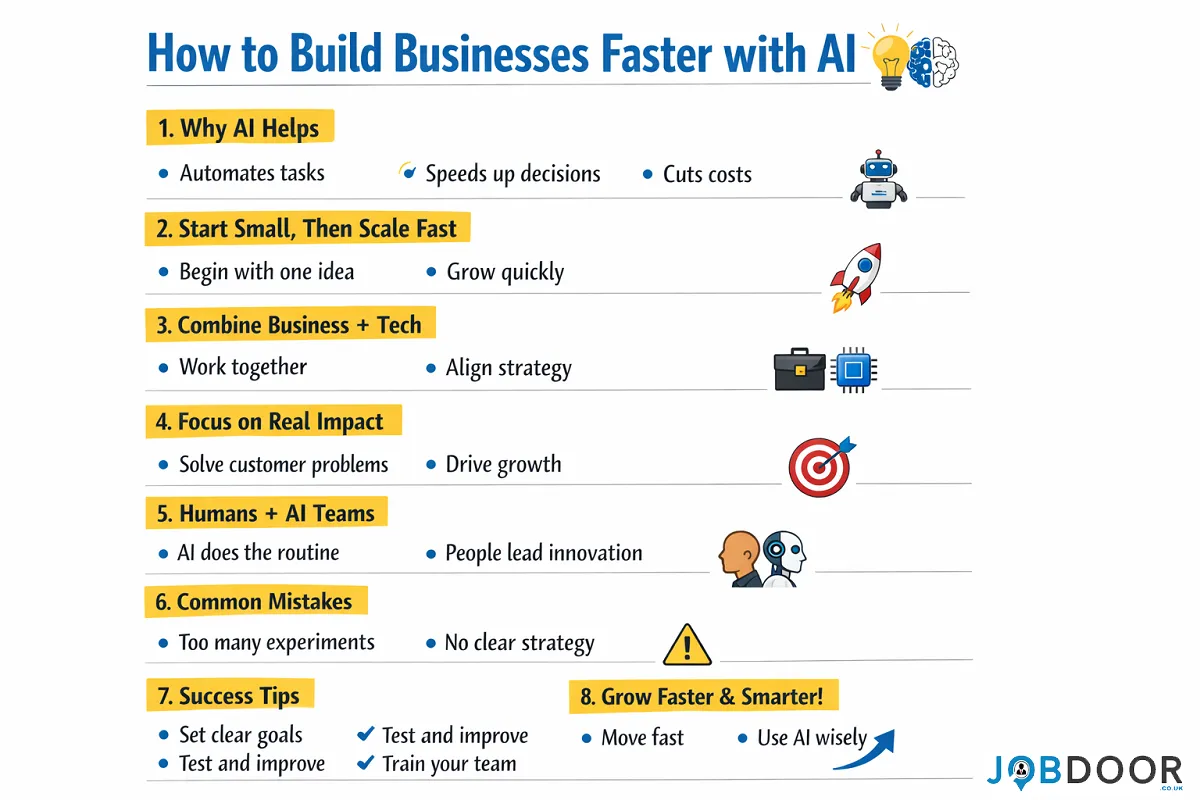
AI is changing more than the software companies use. It is changing how teams plan projects, serve customers, analyse information, create content and make decisions. For workers and job seekers, this shift matters because the value of many roles is moving from repetitive execution towards judgement, communication, problem-solving and effective use of technology.
This guide looks at how AI is changing business workflows, what that means for jobs, which skills are becoming more useful, and how professionals can prepare without trying to become AI engineers.
How AI Is Changing Business Workflows
Traditional business processes often involve several manual steps. Someone collects information, another person checks it, a third person prepares a report, and a manager reviews the final result. AI can assist with parts of this process and reduce the amount of routine work involved.
That does not mean every process should be fully automated. A better approach is to identify tasks where AI can provide a useful first draft, summary, classification, comparison or recommendation while people remain responsible for checking important decisions.
Common workflow changes
- Research: AI can help organise large amounts of information and create initial summaries.
- Writing: Teams can use AI for outlines, drafts, editing and variations of routine communication.
- Customer support: AI can help classify questions and suggest responses for human agents to review.
- Data work: AI can assist with spreadsheet analysis, patterns, calculations and explanations.
- Meetings: AI can turn discussions into summaries, action points and follow-up lists.
- Administration: Repetitive information-handling tasks can often be streamlined with automation.
Why Businesses Are Moving Towards AI-Assisted Work
The biggest opportunity is not simply using an AI chatbot. It is improving the complete workflow around a business task.
For example, a marketing team could use AI to turn customer research into a first content outline, create several draft versions, organise feedback and prepare a publishing checklist. A human still decides what is accurate, useful and suitable for the audience.
This workflow can reduce time spent on low-value preparation while giving employees more time for strategy and quality control.
AI works best when connected to a clear business problem
Companies can waste time by collecting dozens of AI tools without changing any important process. A stronger method is to start with a business problem and then ask whether AI can improve it.
| Business problem | Possible AI-assisted task | Human responsibility |
|---|---|---|
| Too much email | Draft replies and summarise long threads | Check tone, facts and commitments |
| Slow research | Organise information and create a first summary | Verify important claims and sources |
| Long meetings | Create notes and action lists | Confirm decisions and ownership |
| Large spreadsheets | Identify patterns and explain results | Validate calculations and conclusions |
| Repetitive support work | Classify requests and suggest answers | Handle sensitive or complex cases |
How AI Is Changing Jobs
AI is more likely to change the tasks inside many jobs than simply remove an entire job overnight. A role can contain dozens of activities, and only some may be suitable for automation or AI assistance.
This means workers should pay attention to the tasks that make up their role. If a large part of a job involves repetitive information processing, that work may change faster than tasks requiring judgement, relationships, negotiation, leadership or physical activity.
Tasks more likely to be AI-assisted
- Creating routine drafts
- Summarising documents
- Sorting or classifying information
- Basic data analysis
- Routine customer communication
- Creating standard reports
- Research preparation
- Repetitive administrative work
Tasks that still need strong human input
- Making high-impact decisions
- Building trust with customers and colleagues
- Managing people
- Negotiating and persuading
- Understanding unusual situations
- Taking responsibility for outcomes
- Applying professional judgement
- Handling sensitive conversations
The practical lesson is simple: do not only ask whether AI can do your job. Ask which parts of your job AI can assist with, and which parts become more valuable when routine work takes less time.
The Skills Becoming More Valuable in AI-Assisted Workplaces
Technical AI knowledge can help, but it is not the only advantage. Many employers still need people who can think clearly, communicate well and make sound decisions.
1. AI literacy
Workers should understand what AI can do, where it can fail, how to give useful instructions, and when human review is necessary. You do not need advanced programming knowledge to build this skill.
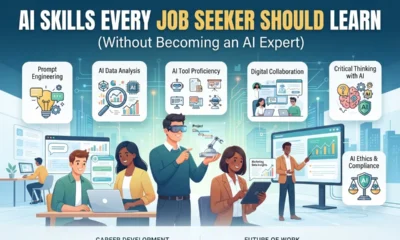
For a broader career-focused guide, see AI skills every job seeker should have.
2. Critical thinking
AI can produce confident-looking answers that still contain mistakes. Employees who can question assumptions, compare evidence and spot weak reasoning can use AI more safely and effectively.
3. Communication
Clear communication becomes even more important when people and AI systems work together. Employees need to explain goals, provide useful context, give feedback and communicate final decisions.
4. Problem-solving
AI is most useful when it is applied to a well-defined problem. Workers who can break a complicated challenge into smaller steps can get more value from AI-assisted workflows.
5. Adaptability
AI tools and workplace processes are changing quickly. The ability to adjust to new systems, workflows and responsibilities can be more useful than knowing one particular tool forever.
6. Domain knowledge
People who understand their industry can often judge AI output better than someone who only knows how to operate the software. Subject knowledge helps employees ask better questions and identify poor recommendations.
How Employees Can Use AI Without Losing Their Professional Value
Using AI effectively does not mean handing every task to a machine. A strong workflow keeps the employee in control.
- Define the task: Be clear about the result you need.
- Give useful context: Include the audience, purpose, format and relevant information.
- Use AI for a first pass: Ask for a draft, summary, analysis or set of options.
- Check the output: Review facts, calculations, tone and missing information.
- Apply your judgement: Adapt the result to the real situation.
- Take responsibility: Do not treat AI output as an automatic final decision.
This approach is more valuable than simply generating large amounts of AI content.
AI and Business Productivity: What to Measure
Businesses should not judge an AI project only by the number of prompts employees use. The better question is whether the workflow has improved.
Useful measures can include:
- Time required to complete a task
- Number of manual steps removed
- Response time for customers
- Error rates before and after the change
- Employee time available for higher-value work
- Customer satisfaction
- Cost of the workflow compared with its previous process
A small improvement in a task performed hundreds of times each month can be more valuable than an impressive AI experiment that nobody uses regularly.
Common Mistakes Businesses Make With AI
Using too many tools
A large collection of AI applications can create confusion. Start with the smallest toolkit that solves a real problem.
Automating before understanding the process
If a business process is already inefficient, automating it may simply make the same problem happen faster. Map the workflow first.
Ignoring human review
AI output can contain factual errors, outdated information, poor reasoning or unsuitable wording. Important work needs appropriate review.
Putting sensitive information into unsuitable systems
Employees should understand company rules before entering confidential customer, employee or business information into an AI service. Privacy and security should be part of the workflow design.
Measuring activity instead of results
More AI-generated output does not automatically mean better performance. Focus on time saved, quality, accuracy, customer outcomes and business value.
What This Means for Job Seekers
AI is becoming part of many workplaces, so job seekers should be ready to discuss how they can work with modern technology rather than simply listing AI tools on a CV.
Instead of writing “I know AI,” show evidence. For example:
- Used AI to speed up research while checking important sources manually.
- Created a repeatable workflow that reduced routine reporting time.
- Used AI to organise customer feedback and identify common themes.
- Built a structured process for drafting and reviewing workplace communication.
- Used AI-assisted analysis to support a business decision.
Specific examples are stronger because they show practical judgement, not just tool familiarity.
Job seekers can also review how to use AI responsibly when applying for jobs and how AI is changing recruitment.
A Simple AI Readiness Plan for Your Career
You do not need to rebuild your career around AI in one week. A practical approach is to improve one workflow at a time.
- List your regular tasks: Write down what you do every week.
- Mark repetitive work: Identify tasks involving copying, sorting, summarising or routine drafting.
- Choose one safe task: Test AI on work where mistakes can be reviewed easily.
- Build a repeatable process: Save the instructions, checks and final steps.
- Measure the result: Compare the time and quality with your old approach.
- Build human skills too: Improve communication, judgement, industry knowledge and problem-solving alongside AI literacy.
This creates a balanced career strategy: use technology to improve productivity while strengthening the skills that remain important when situations are complex.
AI Does Not Replace the Need for Good Management
Businesses still need leaders to decide which problems matter, where automation is appropriate and how employees should use AI responsibly. Technology alone cannot define a good business strategy.
Managers also need to consider training, data protection, quality control, accountability and employee adoption. A technically impressive system can fail if the people expected to use it do not understand the process or trust the results.
Frequently Asked Questions
Will AI replace entire jobs?
Some roles may shrink or change significantly, but many jobs contain a mix of tasks. In many cases, AI is more likely to change how work is performed than remove every part of a role.
Do I need to be a programmer to use AI at work?
No. Many useful workplace applications involve writing, research, communication, analysis and workflow improvement rather than software development.
What is the most useful AI skill for a non-technical worker?
AI literacy is a strong starting point: understanding how to define a task, provide context, review output and use AI responsibly.
Should every business automate as much as possible?
No. Automation should be used where it improves a meaningful process. Tasks involving sensitive decisions, relationships or professional judgement may require strong human involvement.
How can I show AI experience on my CV?
Describe the problem you solved, how you used AI, what you personally contributed and the result. Evidence of improved work is more useful than a long list of tool names.
Related JobDoor Guides
- AI growth and the future of work
- AI tools for small business
- ChatGPT vs Microsoft Copilot for work
- How to choose AI tools for work
Final Thoughts
AI is changing business by reshaping workflows, not simply by adding another software category. Companies can use it to reduce repetitive work, speed up research and improve processes, while employees can use it to spend more time on judgement, communication, problem-solving and valuable human work.
For workers and job seekers, the strongest response is not to chase every new AI tool. Build practical AI literacy, understand your own work, improve one workflow at a time and keep developing the human skills that help you make good decisions.
The future of work will not be about humans or AI working separately. For many roles, the advantage will come from knowing how to make the two work well together.








How to Start a Career in Sports and Leisure in the UK
A practical guide to sports and leisure careers in the UK, covering jobs, qualifications, apprenticeships, skills, experience, CVs and career...


How to Start a Career in Travel and Tourism in the UK
Travel and tourism is a broad career sector with opportunities in travel agencies, airports, airlines, visitor attractions, tours, hotels, heritage...


How to Start a Career in Property and Real Estate in the UK
Property and real estate is a broad career field covering residential property, commercial buildings, land, development, valuation, lettings, property management...


How to Start a Career in Hospitality in the UK
Thinking about hospitality as a career in the UK? Compare hotel, restaurant and guest service roles, entry routes, skills, apprenticeships...


How to Start a Career in Retail in the UK
Thinking about a retail career in the UK? Compare retail roles, entry routes, apprenticeships, skills, experience, CV tips and ways...


How to Start a Career in Science and Research in the UK
Planning a science or research career in the UK? Compare career paths, qualifications, apprenticeships, skills and practical ways to get...


How to Start a Career in Law in the UK
Thinking about a career in law? This guide explains UK legal career routes, qualifications, solicitor and barrister pathways, apprenticeships, skills,...


How to Start a Career in Education in the UK
Thinking about a career in education? Compare teaching and non-teaching roles, qualifications, apprenticeships, experience, skills and practical steps for getting...


How to Start a Career in Marketing in the UK
Marketing is a broad career field that combines communication, creativity, research, data and business thinking. It includes traditional marketing as...


How to Start a Career in Healthcare in the UK
Healthcare is one of the UK’s broadest career areas. It includes doctors and nurses, but also healthcare assistants, laboratory staff,...


How to Start a Career in Human Resources (HR) in the UK
Photo by Vitaly Gariev on Unsplash Human resources, usually called HR, is a people-focused career that combines communication, organisation, business...


How to Start a Career in Construction in the UK
Construction is one of the UK’s broadest career sectors. It includes hands-on trades such as bricklaying, carpentry and plumbing, as...


How to Start a Career in Energy and Utilities in the UK
Planning a career in energy and utilities in the UK? See job options, apprenticeships, qualifications, skills and practical steps to...


How to Start a Career in Media and Communications in the UK
Planning a media and communications career in the UK? Compare job options, entry routes, apprenticeships, skills, experience and practical steps...


How to Start a Career in Environmental and Sustainability Jobs in the UK
Environmental and sustainability careers are becoming an important part of many UK workplaces. Jobs in this area can involve protecting...


How to Start a Career in Cybersecurity in the UK
Thinking about a cybersecurity career in the UK? Here is a practical guide to skills, qualifications, entry-level roles, applications and...


How to Start a Career in Engineering in the UK
Thinking about engineering as a career in the UK? Here is a practical guide to engineering fields, qualifications, apprenticeships, skills,...


How to Start a Career in Government and Public Services in the UK
Thinking about a career in government or public services? This guide covers job options, entry routes, apprenticeships, skills, applications and...


Rolls-Royce Internship UK: Eligibility, Opportunities & How to Apply
Find Rolls-Royce internships in the UK with practical guidance on eligibility, opportunities, applications, assessments, skills and preparation.


How to Start a Career in Transport and Logistics in the UK
Planning a career in transport and logistics in the UK? See entry-level roles, apprenticeships, qualifications, skills and practical steps to...
-
 Career3 years ago
Flexible Jobs for Older Adults in the UK: 7 Career Options
-
 How-to8 months ago
How to Use Google Gemini for Freelance Work and Career Skills
-
 Jobs8 months ago
Second Jobs in the UK: 15 Practical Ways to Earn Extra Income
-

 Career2 years ago
Free Job Posting Sites in the UK: Options for Employers
-
 How-to8 months ago
How to Build Passive Income: 20 Income-Producing Assets for Long-Term Financial Growth
-

 AI & Tools8 months ago
How to Use Google Gemini for Productivity at Work
-

 Job Description3 years ago
Support Worker Job Description: Duties, Skills, Salary and Career Guide UK
-

 AI & Tools8 months ago
ChatGPT vs Microsoft Copilot: Which AI Is Best for You?